 This website was archived on December 19, 2017 and is no longer updated.

Project coordination

April 15 and 16, 2014: 4th LowInputBreeds Symposium
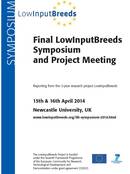
April 15 and 16, 2014: 4th LowInputBreeds Symposium in Newcastle, UK
- Symposium page
 Flyer (481 KB)
- Registration form
Third LowInputBreeds Symposium

Breeding and Management in Low Input Production Systems
= LowInputBreeds Session at the 64th Annual Meeting of the European Federation of Animal Science (EAAP)
- Date: August 26 to 30, 2013
- Venue: Nantes, France
- Organisation: National Institute of Agronomic Research INRA
- www.eaap2013.org

- www.lowinputbreeds.org/lib-symposium-2013.html
Second LowInputBreeds Symposium

Feeding and management strategies to improve livestock productivity, welfare and product quality under climate change
= 14th International Seminar of the FAO-CIHEAM Network on Sheep and Goats Sub-Network on Nutrition and 2nd Symposium of the LowInputBreeds project
- Date: May 15 to 18, 2012
- Venue: Hammamet, Tunisia
- Organisation: National Institute of Agricultural Research of Tunisia (INRAT) and the Pasture and Livestock Agency (OEP-Tunisia) & Mediterranean Agronomic Institute of Zaragoza (CIHEAM-IAMZ)
- Key documents
- Second announcement (209 KB)
- Programme of May 18th, with the presentations about the progress of the LowInputBreeds project (155 KB)
- Website www.iamz.ciheam.org/tunisia2012 and www.lowinputbreeds.org/symposium-2012.html
First LowInputBreeds Symposium on Ethical Consideration in Livestock Breeding
First LowInputBreeds Symposium on Ethical Consideration in Livestock Breeding
March 15 and 16, 2011, Wageningen, The Netherlands
www.lowinputbreeds.org/symposium-2011.html
LowInputBreeds project events
The LowInputBreeds project organises several events in order to guarantee the optimum dissemination of the project's results. The LowInputBreeds website informs about the project's events.
Four symposia
The four LowInputBreeds symposia:
- The first symposium took place on March 15 and 16, 2011 and was be organised by the Animal Sciences Group of Wageningen University and Research Centre (Partner 4).
- The second LowInputBreeds symposium took place in May 2012 in Tunisia, organized by the National Agricultural Research Institute of Tunisia.
- The third symposium took place in August 2013 in Nantes, France, in the framework of the 64th EAAP Annual meeting.
- The fourth Symposium in Newcastle, UK, on April 15 to 16, 2014.
Specialist training workshops for early stage researchers and agricultural advisors
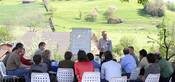 |
Four workshops are taking place, open to both early stage researchers and agricultural advisors/technologists to facilitate an exchange of ideas/opinions and know-how and encourage potential future collaboration between the two target groups.
The workshops:
- Methods and strategies in farmer-participatory selection/breeding
- Breeding for ‘robustness’, and quality traits; theory and practice
- Methods/strategies for genome-wide and marker assisted selection/breeding
- Animal health and welfare management in organic and ‘low input’ production systems
- Feeding regimes in organic and ‘low input’ ruminant and monogastric production systems
Each workshop accommodates up to 15 researchers from partner organisations and 15 participants from organisations not involved in the consortium. The workshops are advertised on the LowInputBreeds website.
Organisation of an exchange programme for scientists between laboratories involved in the LowInputBreeds project
 |
An exchange programme for early stage researchers involved in the LowInputBreeds activities will be developed.
This will contribute to addressing
- the training needs identified in individual development plans for junior researchers (identified by individual partner organisations) and
- the needs for training in specific techniques/methodologies identified by partner institutions.